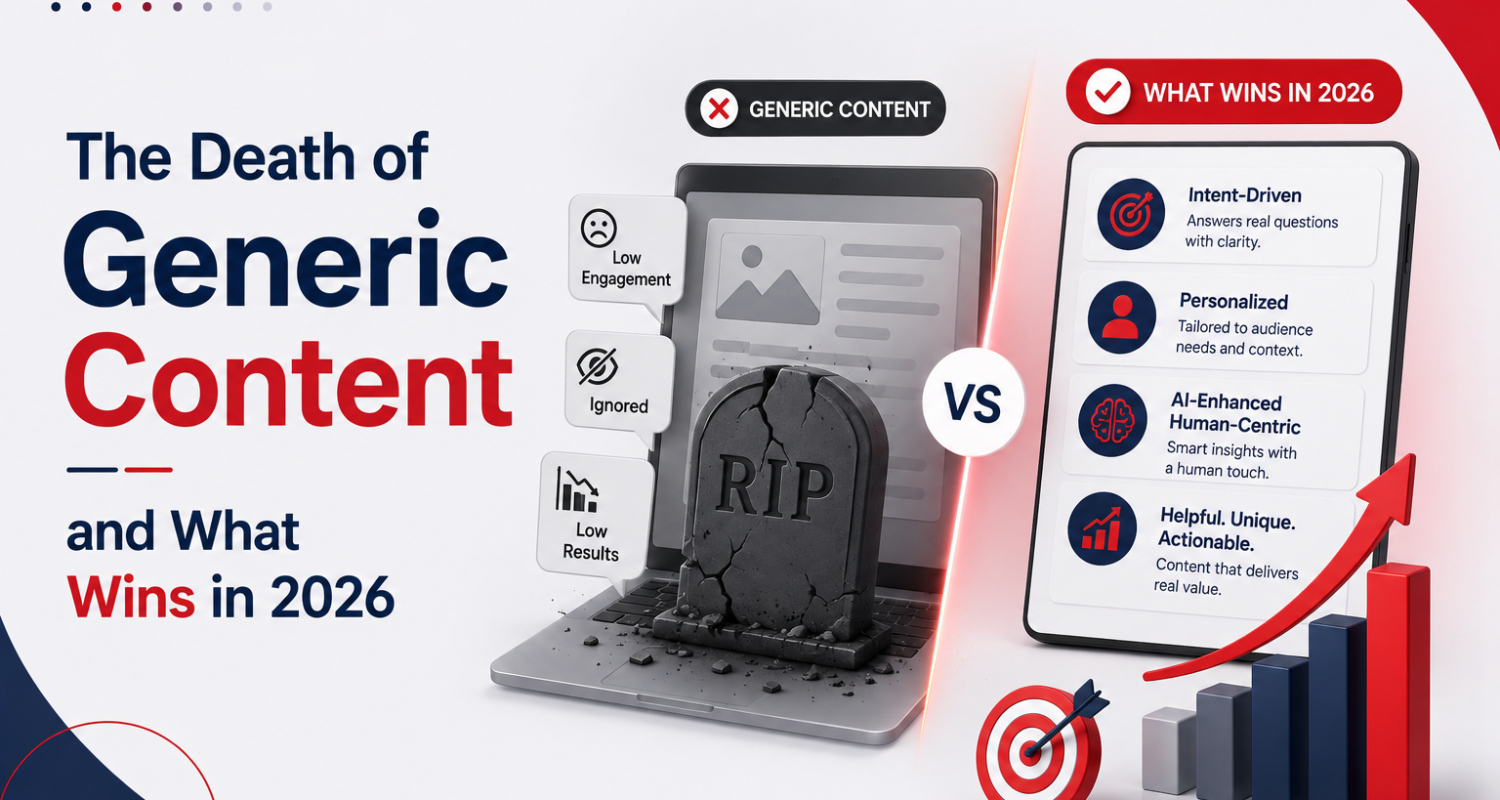
Open any search bar or social feed today, and the noise is deafening. Over the past three years, generative tools lowered the technical barrier to publishing to zero, unleashing a tidal wave of synthetic text across the web. Modern audiences didn’t just adapt – they developed a sharp, reflexive filter for superficial fluff.
Search platforms like Google and Perplexity responded by tuning their systems to aggressively reward Information Gain. Algorithms now strip rank from domains that simply summarize existing web pages. When any organization can push out twenty surface-level articles a day with a single prompt, basic information becomes a commodity. Commodity text commands zero attention, builds zero trust, and drives zero revenue.
Generic copy is dead. Winning in 2026 requires abandoning low-effort volume and partnering with modern content marketing services to build a strategy rooted in original research, distinct points of view, and deep human perspective.
Why the Web Reached Content Saturation
The rapid decay of generic text isn’t an accident. It is the natural result of three structural shifts that transformed reader behavior and search indexing over the last 24 months.
- The Synthetic Flood– Automated pipelines turned content creation from a deliberate craft into an industrial manufacturing game. The web was overwhelmed by millions of blogs repeating identical points using slightly varied phrasing.
- Algorithmic Correction– Search platforms evolved far beyond traditional backlink counting and basic keyword matching. Core algorithm updates now evaluate whether a piece adds unique value or merely regurgitates top-ranking search results without bringing new facts, original data, or personal experience to the table.
- Changing Reader Habits– Users no longer want to dig through five paragraphs of fluff to find a standard answer. They consult conversational engines like ChatGPT or Perplexity for quick summaries, visiting actual websites only when seeking deep technical analysis, verifiable case studies, or trusted expert direction.
When surface-level facts are instantly available inside conversational interfaces, standard explainer posts lose their commercial value entirely.
What Actually Converts – The Pillars of High-Value Content
Standing out in an automated environment requires changing your core definition of quality. Success no longer means publishing comprehensive guides that explain basic concepts; it means demonstrating how your team solves complex, real-world problems.
To build sustainable digital authority today, executing an original content strategy relies on four essential pillars-
1. Proprietary Data and Primary Research
If your articles rely entirely on facts scraped from existing blogs, they carry no unique market value. High-performing brands conduct original surveys, analyze internal customer usage metrics, and publish raw benchmarks. Unique datasets create natural backlink magnets that conversational search engines reference as primary sources.
2. Verified Subject Matter Expertise
Search crawlers and humans both seek out proof of practical experience (E-E-A-T). Detached and objective articles fail to resonate. Top-performing articles include firsthand quotes, teardowns, and playbooks from engineers, strategists, and executives who are doing the work themselves. crawlers and humans both seek out proof of practical experience (E-E-A-T). Detached and objective articles fail to resonate. Top-performing articles include firsthand quotes, teardowns, and playbooks from engineers, strategists, and executives who are doing the work themselves.
3. Contrarian and Sharp Perspectives
Generic copy tries to satisfy everyone and ends up inspiring no one. Modern audiences resonate with clear, defensible viewpoints. Taking a firm, well-reasoned stand on industry debates – backed by hard evidence – sparks genuine engagement, social discussions, and brand recall.
4. Technical Depth and Specificity
Vague advice like “optimize your workflow” or “focus on customer experience” is useless to experienced buyers. Modern readers demand high-quality content marketing built on exact frameworks, specific code snippets, detailed process flows, and step-by-step post-mortems that can be applied immediately to their own operations.
Navigating AI Content vs Human Content
The debate isn’t about choosing between AI content vs human content. It’s about understanding where technology builds operational efficiency and where it destroys brand equity.
Using generative models to draft complete articles creates predictable, uniform language patterns. There’s no narrative cadence to these pieces, formulaic transitions, and zero new insights. Readers instantly recognize these patterns and leave the page, boosting bounce rates.
Smart brands blend the latest technology with the most rigorous human editorial oversight. They use software to speed up data extraction, analyze gaps in user intent, and proofread outlines. Yet the core story, strategic positioning, and personal anecdotes remain strictly human.
- Research Sourcing– Synthetic-first models rely on scraped summaries, while modern human-led workflows incorporate primary interviews, proprietary metrics, and real-world experiments.
- Tone and Voice– Automated output produces neutral, formulaic text. Human-led execution yields distinct, authoritative, and opinionated perspectives.
- Core Objective– Machine generation prioritizes publishing volume, whereas strategic human oversight focuses on driving user trust, brand citations, and revenue conversions.
- Search Performance– Unedited synthetic text remains vulnerable to core algorithm updates, while data-rich human analysis stays resilient and frequently cited across AI answer engines.
Rebuilding Your Editorial Strategy for 2026
Modernizing an outdated publishing model requires structural changes across your editorial pipeline, from topic selection to final distribution.
Shift from Volume to Value
Publishing two deep, highly researched pieces a month yields far better returns than releasing twenty generic posts. Every piece of content should pass a strict test – Does this contain information that cannot be found anywhere else on the web? If the answer is no, scrap the topic or rethink the angle.
Invest in Modern Content Marketing Services
Executing a sophisticated publishing strategy demands multi-disciplinary skills. Leading content marketing services no longer focus just on churning out basic blog posts. Instead, they operate like specialized media teams – combining data analysis, technical interviews, visual design, and distribution playbooks to turn raw company knowledge into category-defining digital assets.
Build a Content Differentiation Playbook
To ensure your team consistently produces original work, establish explicit editorial rules-
- Every article must cite at least one internal data point, benchmark, or real customer example.
- Abstract claims must be paired with concrete, real-world implementations.
- Outlines must include a clear, opinionated thesis statement before drafting begins.
- Drafts must undergo rigorous editing to strip out corporate fluff, filler phrases, and repetitive structures.
Focus on Information Gain and Content Differentiation
True content differentiation happens when you solve specific, complex problems for narrow target audiences. Stop writing broad guides for beginners unless you have a completely unique framework to share. Focus instead on mid-funnel and bottom-funnel technical topics where your team’s real-world experience provides an unbeatable advantage.
Developing Thought Leadership Content That Scales
Building sustainable authority requires turning executive insights into scalable media assets. Real thought leadership content cannot be faked or automated by prompts because it depends on lived experience and strategic foresight.
- Extract Executive Insights Regularly– Schedule bi-weekly, 20-minute interviews with subject matter experts, engineers, and leadership. Extract their real-time takes on industry changes, recent client wins, and operational mistakes.
- Transform Single Insights into Multi-Format Assets– A single data-backed report can be repurposed into a long-form strategic guide, multiple data graphics for social channels, an executive newsletter, and commentary for industry outlets.
- Maintain an Original Content Strategy– Align your publication flow directly with your business objectives. This means each piece of content you publish is linked to the unique proposition that makes your offering valuable, establishing your brand as an expert before any sales conversation takes place.
This strategy will raise your profile above the noise of algorithmically generated text.
Concluding Thoughts
The death of digital fluff isn’t a crisis – it’s a long-overdue cleanup. Readers no longer tolerate wading through filler for simple answers, raising the bar permanently for modern content marketing services. Surface-level rewriting is dead – building lasting digital authority now requires original benchmarks, direct experience, and fresh perspectives that machines cannot replicate.
Before teams hit publish, they need to ensure their draft provides real, net-new value – not just reiterating facts that an answer engine can summarize in seconds. The winning formula for 2026 is simple – don’t try to out-publish the machines, but out-think, out-research, and out-reason them. The web will be awash with predictable text from low-effort publishers. But the only ones worth listening to will be the creators who are giving real human expertise.