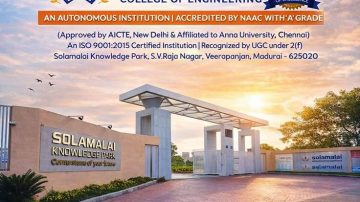
Every year, a fresh batch of twelfth-grade students sits with their parents, staring at a course selection form, unsure whether to pick something familiar like Computer Science or take a chance on a newer stream like Artificial Intelligence and Data Science. Solamalai College of Engineering, one of the well-known madurai btech colleges, runs exactly this program, and the sections below cover how the four years are structured, what students end up learning, and where graduates typically find work
Why This Stream Lives in the First Place
A decade ago, most engineering students learned programming, databases, and networking as separate, somewhat disconnected subjects. Industries now want graduates who can pull all three together to build systems that learn from data and make decisions on their own. That’s essentially the gap this specialization tries to close. Instead of treating artificial intelligence as an elective add-on, the entire four years are structured around it – from the way problems are framed in first-year assignments to the kind of final-year projects students are pushed toward.
At Solamalai College of Engineering, this approach is paired with a strong push toward staying connected to actual companies rather than sticking purely to textbook theory. Students get pulled into sponsored projects and ongoing research work alongside coursework, which changes how the subject feels – less like memorizing definitions, more like solving problems someone actually needs solved.
What You’ll Actually Be Doing on Campus
It helps to break the four years into rough phases instead of thinking of it as one long, undifferentiated stretch.
Early years are foundational – programming logic, data structures, basic electronics, and an introduction to how machines process and store information. This part can feel slow if you’re expecting robots and self-driving cars on day one, but it’s the groundwork everything else depends on.
Middle years start bringing in the specialized material: database systems, cloud computing, networking fundamentals, and the beginnings of machine learning and soft computing techniques. This is also usually when students start noticing which direction they personally lean toward – some get pulled into hardware and embedded systems, others gravitate toward pure software and app-building.
Final years are where things get hands-on in a serious way – dissertation-style projects, internships, and increasingly, exposure to mechatronics and microcontroller-based systems for students who want a blend of hardware and intelligent software rather than pure coding.
The faculty guiding students through this aren’t limited to one narrow specialty either – you’ll find people with backgrounds spanning database architecture, mobile operating systems, and soft computing, which means the guidance you get shifts depending on which corner of the field you’re curious about.
What This Program Really Teaches You
A lot of what students pick up in this kind of program doesn’t show up neatly on a syllabus sheet. By the time you’re midway through, you’re usually comfortable with:
-
Designing systems that solve complex calculation problems rather than just writing code line by line
-
Understanding how networks, servers, and communication protocols like VOIP or instant messaging actually function underneath the apps we use daily
-
Working with circuit boards, processors, and memory components at a level deeper than most software-only graduates ever touch
-
Building applications with real attention to how humans interact with machines, not just whether the code compiles
That last point matters more than people expect. A huge part of this field isn’t just building intelligent systems – it’s building ones people can actually use without frustration.
The Kind of Jobs This Course Leads To
One fair question before committing four years of your life to any stream is: what happens on the other side? Graduates from this kind of program generally move into a fairly wide spread of roles rather than one narrow lane. Game development studios hire for logic and systems thinking. Robotics and hardware companies look for people comfortable with both circuits and code. Web and UX-focused teams want graduates who understand the backend enough to build smooth front-end experiences. There’s also steady demand from multimedia companies and IT consulting firms that need people who can analyze a client’s systems and suggest improvements.
None of these paths are guaranteed just by enrolling, of course — like any technical field, outcomes depend heavily on how much initiative a student takes beyond scheduled classes, whether that’s contributing to a funded research project, building a personal portfolio, or picking up certifications on the side.
A Few Honest Things to Check Before You Enroll Anywhere
If you’re comparing this specialization across different institutions, a few questions are worth asking directly rather than assuming:
-
Are the labs actually updated for AI and data work, or just repurposed computer labs from a decade ago?
-
Does the faculty have real project or industry exposure, or purely academic backgrounds?
-
What percentage of final-year students land internships tied to their specialization, rather than generic placement drives?
-
Is there a genuine research culture, or is “funded projects” just a line in a brochure?
Reaching out directly to a department – in Solamalai College of Engineering, the Artificial Intelligence and Data Science Department handles queries for this specialization – and asking these questions honestly tells you more than any glossy prospectus will. It’s a small step, but among madurai btech colleges, the ones willing to answer such questions openly are usually the ones worth taking seriously.
Coclusion
Enrolling in an Artificial Intelligence and Data Science program is a decision that above academic interest; it involves evaluating how a curriculum balances hardware, software, and human-centered design across four years of study. The program at Solamalai College of Engineering appears structured with this balance in mind, though the extent to which a student benefits will ultimately depend on their own engagement with coursework, projects, and available research opportunities.
Future students are advised to visit the campus during a regular academic day rather than a promotional event, engage directly with currently enrolled students, and request verifiable data on internship placements and ongoing research initiatives from the department. Such due diligence remains the most reliable method of distinguishing a program with substantive academic and career value from one that is primarily marketed as such.