Growth puts pressure on every part of the operating model, but hiring feels it first. Once a company starts expanding, the real question is no longer how to fill roles. It is how to add capability without slowing execution, inflating fixed cost, or pulling leadership away from the business.
That is where the choice between staff augmentation services and a permanent team becomes important. One model gives speed and flexibility. The other gives depth and continuity. The stronger option depends on the work itself, the pace of change, and how much control the business needs to keep.
In this blog, we compare staff augmentation and in-house hiring to help businesses choose the right approach for sustainable growth and effective team scaling.
Why Does this Decision Matters More Now?
The current market is rewarding adaptability. Work is being reshaped by AI, changing skill requirements, and shorter planning cycles. Deloitte’s 2025 research shows the tension clearly – 75% of workers want greater stability, while 85% of executives say organizations need more agile ways of organizing work.
At the same time, the World Economic Forum reports that nearly 40% of core skills will change by 2030, and 63% of employers already see skills gaps as the main barrier to transformation.
That combination is pushing companies toward more flexible workforce strategy planning instead of relying on one fixed hiring model for every need.
When Staff Augmentation Services Make the Stronger Case?
Staff augmentation services are the better choice when the need is specific, temporary, and tied to delivery speed. It works best when the business already knows what outcome it needs but does not want to lock in a permanent hire for work that may change again soon.
This model fits well for:
- project-based work with clear timelines
- specialist roles that are hard to recruit for quickly
- temporary capacity gaps during growth spikes
- technical or campaign-heavy work that needs fast execution
In practical terms, staff augmentation services help a company stay lean while still moving quickly. For digital marketing staffing, product rollouts, cloud work, QA, or design support, the model can reduce delay and protect the core team from overload.
Recent market research also supports the shift toward flexible project talent. A 2025 Harvard Business Review piece found that more agile companies are 1.6 times more likely to increase their use of freelancers in the coming year.
When In–House Hiring is the Better Investment?
Permanent hiring makes more sense when the role is central to the business and must compound over time. If the work requires deep institutional knowledge, long-term ownership, or close alignment with culture and customers, internal hiring usually wins.
This is especially true for:
- leadership roles
- core product and service functions
- customer relationship ownership
- long-term process design
- functions tied to proprietary knowledge
In-house hiring builds continuity. It creates stronger memory inside the business, improves decision-making over time, and reduces dependence on outside support for core functions. For work that defines the company’s future, that matters more than short-term speed.
Staff Augmentation vs In-House Hiring – A Practical Comparison
|
Factor |
Staff augmentation services | In-house hiring |
|
Speed |
Faster access to talent |
Slower due to sourcing and onboarding |
|
Cost structure |
Better for short-term or variable demand |
Better for long-term, recurring needs |
|
Flexibility |
High |
Lower |
|
Ownership |
Strong on delivery, lighter on long-term ownership |
Strong on accountability and continuity |
|
Knowledge retention |
Limited to the project timeline |
Builds internal memory over time |
| Best use case | Campaigns, launches, specialist gaps |
Core functions, leadership, institutional work |
A Better Way to Decide
The choice becomes clearer when the business asks a few practical questions:
- Is this work temporary or permanent?
- Does it require deep internal context?
- Will the skill be needed again after this phase?
- Is speed more important than long-term ownership?
- Does the role sit close to the company’s core value proposition?
If the answer points to a short-duration need, staff augmentation services are usually the smarter move. If the work is central, recurring, and tied to long-term control, in-house hiring is the better investment.
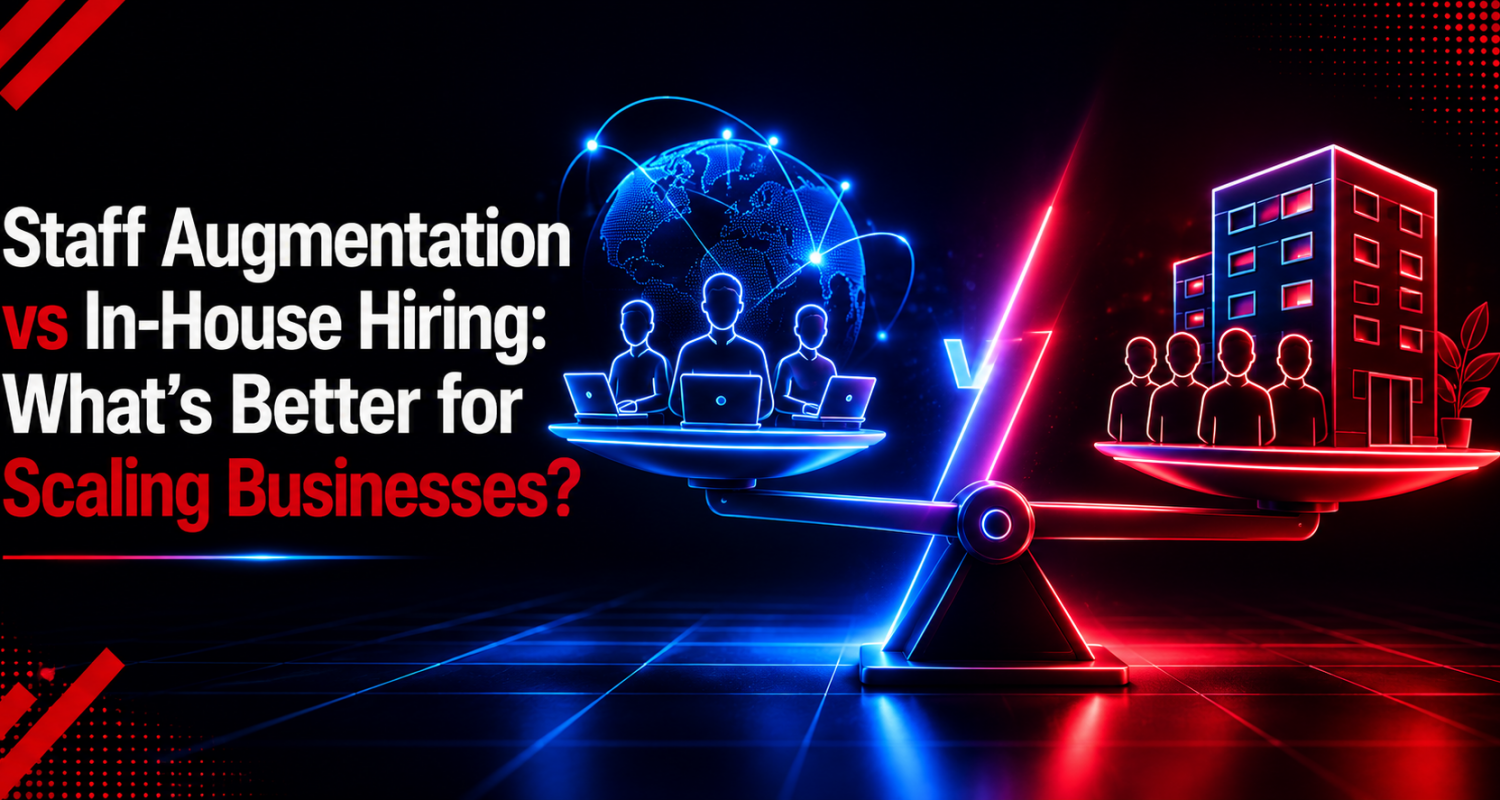
For many scaling businesses, the strongest approach is not one model alone. A hybrid approach is often the most efficient answer because growth is rarely uniform. Some parts of the business need permanence. Others need adaptability. A strong workforce strategy respects that difference.
That is why outsourcing vs in-house is no longer the right framing on its own. The better question is – which roles should stay internal, and which should be extended through flexible talent?
For many businesses, the answer is clear. The core stays inside. The surge capacity comes from outside. That balance reduces risk, keeps the team lean, and protects execution when demand changes quickly.
Conclusion
The best choice depends on the role, the timeline, and the business stage. In-house hiring is the stronger model for core functions that require long-term ownership. Staff augmentation services are the better option when speed, flexibility, and specialized execution matter most. For scaling businesses, the most effective workforce model is usually not one or the other. It is a deliberate combination of both, a stable internal team supported by flexible external expertise, when and where the business needs it most.